
About Is It Golf?
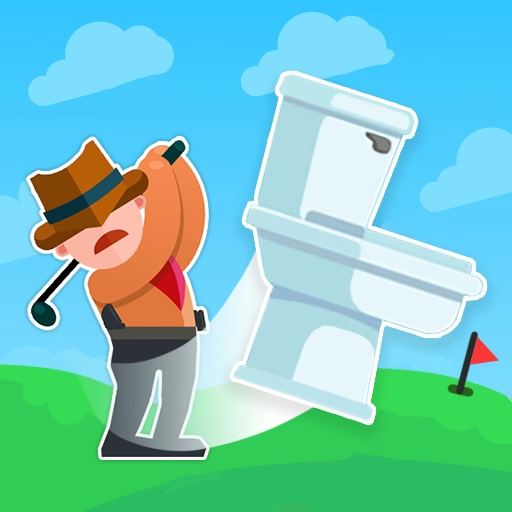
Begin Is It Golf? by checking what you are launching. A level can give you a familiar ball, but it can also replace it with a sheep, a car, a chicken, or another unlikely object. The destination remains a marked flag, while the scene asks you to treat an unusual shape as the thing that must complete the route.
The action is still based on aiming and choosing launch strength. Prepare the gesture, release, and watch the object move through the course. Obstacles make careless force costly, and a setting that worked for one arrangement may be inappropriate for the next. Read each level as a fresh problem: identify the object, locate the flag, and choose a clear path before committing to the joke’s physical consequences.
How to Play Is It Golf?
Hold and drag to aim the current object, then release to launch it toward the marked flag. Adjust the strength for the layout and avoid obstacles that interrupt the route.
- Identify the object you control and locate the flag.
- Inspect the obstacles between the start and target.
- Prepare direction and strength, then release the launch.
- Observe the result and adapt the next attempt or level to its particular setup.
Controls & Timing
The object changes the reading
A car or animal is visually different from a small golf ball. Inspect its position and available clearance instead of aiming as though every level has the same starting arrangement.
The flag remains the goal
The unusual object does not remove the destination requirement. Choose a route that carries it to the marked target rather than launching simply to see how far it travels.
Force needs context
The same strength can be unsuitable on a short course or near an obstacle. Reassess the required movement each time the level changes.
Controls
| Input | Action | When to use |
|---|---|---|
| Hold the aiming input | Prepare the object’s launch. | At the beginning of a shot. |
| Drag | Choose direction and launch strength. | While checking the route to the flag. |
| Release | Send the object toward the target. | When the setup is ready. |
High Score Tips
- Read before repeating. A successful launch can become a habit, but the next object or obstacle layout may call for something else. Pause to establish the new target line before using the previous gesture.
- Leave clearance beside obstacles. A route that barely passes an obstruction gives little room for error. Prefer a clear lane when it reaches the flag without requiring a difficult contact.
- Treat the first miss as evidence. Watch where the object first deviates from the intended route. A collision asks for an angle change; travelling cleanly past the target usually asks for a strength adjustment.
- Keep the finish in view. A funny launch is not necessarily a successful one. Judge the whole movement by whether it reaches the flag, including what happens after an obstacle or landing changes the path.
Key Features
- Unconventional golf objects. Animals, vehicles, and other props can replace the normal ball.
- Flag-based targets. Each level keeps a clear destination despite the changing setup.
- Three-dimensional scenes. Object placement and obstacles shape the launch route.
- Simple preparation. Dragging and releasing lets you focus on reading the current challenge.
Frequently Asked Questions
Do I always launch a golf ball?
No. Different levels use unusual objects such as animals or vehicles. Check what you control before preparing the shot, then plan its route to the flag in the current scene.
What is the goal of each level?
Bring the controlled object to the marked flag. The changing props provide the humour, but success still depends on preparing a direction and strength that complete the route.
How do I control the launch?
Hold and drag to prepare direction and strength, then release. Inspect the target and nearby obstacles first so the gesture is based on the current arrangement rather than a repeated guess.
Why should I change a shot that worked earlier?
The next level can place a different object among different obstacles. Recheck the distance and clearance instead of assuming that the previous angle and force remain appropriate.
What should I change after overshooting?
If the object followed a clear line but travelled beyond the target, reduce strength first. Preserve the useful direction so the next attempt tests the distance correction instead of a completely new route.