



About Golf Puzzle
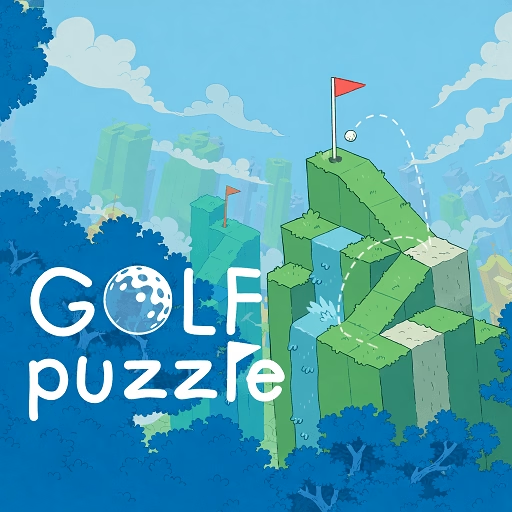
Golf Puzzle replaces the swing with a planning problem. Each card represents a particular movement, and your task is to choose the direction and order that will bring the ball to the hole. You are reading a small course and a limited set of options, rather than trying to stop a power meter at the right instant.
The mountain setting introduces terrain and hazards that make a direct-looking route less straightforward. A useful move is one that leaves the ball in a position the remaining cards can solve. That is the central satisfaction of the game: seeing an entire sequence work, including the apparently modest first move that made the final landing possible. Courses progress through a large collection of puzzles with changing layouts.
How to Play Golf Puzzle
Select a movement card and a direction to move the ball toward the hole. Plan the order of your cards around the course’s hazards, and retry with a revised sequence when the current route cannot finish.
- Identify the starting tile, target hole, and hazardous areas.
- Read the movement represented by each available card.
- Choose the order and direction of moves before spending the first card.
- Play the sequence, checking each landing against the remaining options.
Controls & Timing
Order changes the route
The same collection of movement options can produce different positions when played in another sequence. Treat the hand as a route-building problem, not a list to use from left to right.
Landing with a next move
Getting closer to the hole is not sufficient if the remaining cards cannot complete the approach. Evaluate the position after a move and the continuation it allows.
Terrain interrupts simple counting
Water, sand, and hills complicate the layout. Include them in the plan instead of measuring only the straight distance between the start and hole.
Controls
| Input | Action | When to use |
|---|---|---|
| Select a card | Choose a movement option. | After inspecting the available hand. |
| Choose a direction | Set where that move will take the ball. | Before committing the selected card. |
| Use the game’s retry option | Begin another attempt at the puzzle. | When revising an unsuccessful sequence. |
High Score Tips
- Plan the last move first. Find a position from which one of your cards can reach the hole. Then ask which earlier moves can place the ball there; this can narrow a confusing set of choices.
- Preserve a useful short move. Do not spend a precise movement merely because it is convenient at the start. It may be the only option that completes the final approach.
- Trace every landing. An imagined route can skip over an important terrain detail. Check where each card actually leaves the ball before committing to the sequence.
- Change a specific part of a failed plan. Try a different order or direction while remembering what the previous attempt taught you. Randomly replacing every move makes it harder to learn why a route failed.
Key Features
- Card-controlled golf. Movement choices replace club swings and power timing.
- Tile-based planning. Direction and travel amount define the route to the cup.
- Mountain puzzles. Changing terrain gives the same simple objective new constraints.
- Progressive course collection. Completing a puzzle opens further layouts to solve.
Frequently Asked Questions
Do I need to time a golf swing?
No. The central mechanic is selecting movement cards and directions. Success depends on the route those decisions create, so careful planning is more useful than quick reflexes.
Why can a move toward the hole be wrong?
It can leave the ball at a distance or position that the remaining cards cannot handle. Judge each move by the continuation it enables, not only by how close it looks.
What should I inspect first?
Look at the hole, the available cards, and the hazardous terrain together. Understanding only one of those elements is not enough to build a complete sequence.
How should I approach a difficult puzzle?
Work backward from a possible final shot, then test which earlier positions lead to it. If that route fails, change one assumption and use the failed attempt as information.
Why does card order matter?
Each move changes the starting position for the next one. A card that seems unhelpful now may become the finishing move later, so evaluate the whole sequence before spending it.